Summary
Exploring the turmoil surrounding recent far-right demonstrations in France reveals a complex and deeply polarized political landscape marked by historical legacies, rising nationalist sentiments, and escalating social unrest. Far-right movements such as the National Rally (Rassemblement National, RN) and the monarchist Action Française have played prominent roles in mobilizing support through nationalist and ethnonationalist ideologies that emphasize exclusionary identities and opposition to immigration. The RN’s significant electoral gains, including a majority in the 2024 European Parliament elections, have heightened fears of a far-right government for the first time since World War II, prompting widespread protests and political counter-mobilization.
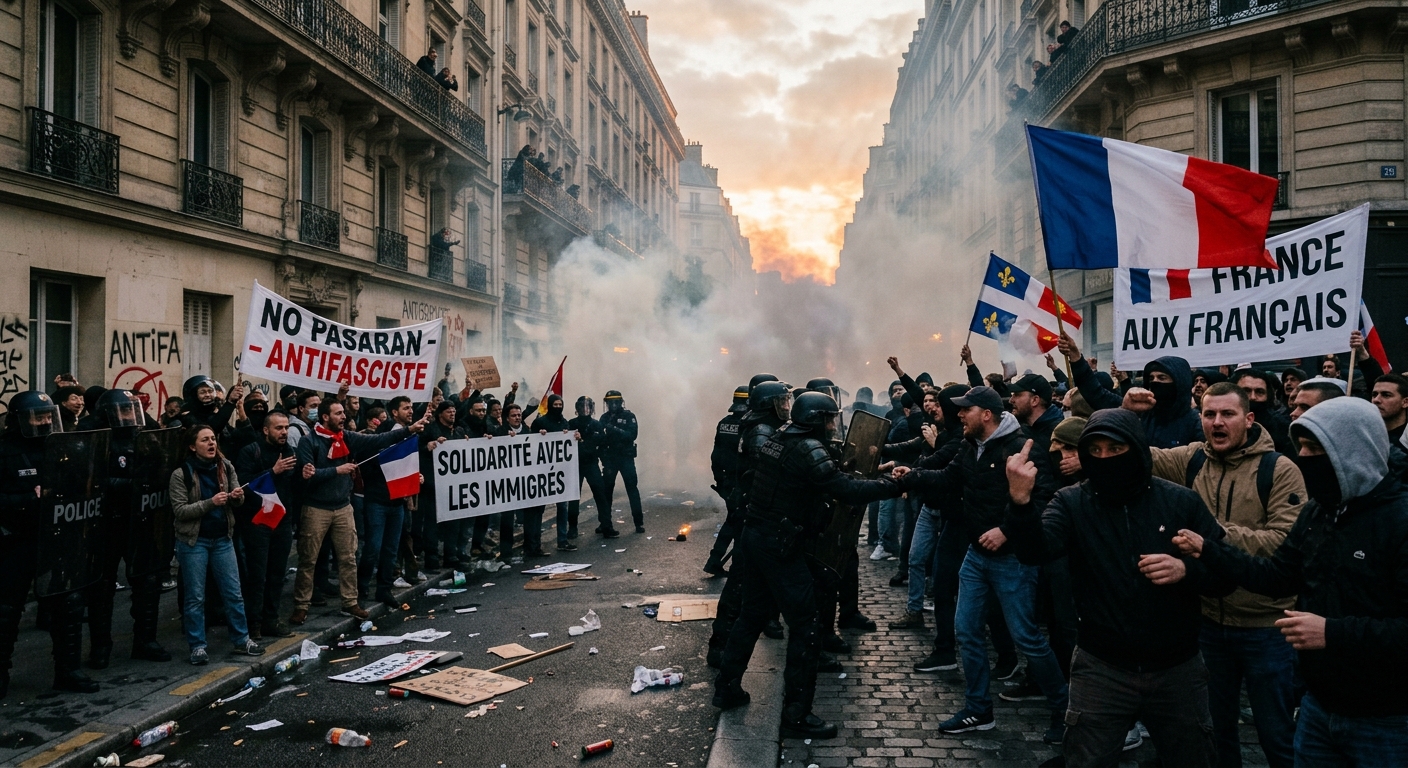
The demonstrations have frequently been accompanied by violent incidents, including racist and homophobic chants, Nazi salutes, and clashes with police, illustrating the volatile fringe elements within the far-right mobilization. These tensions have been further exacerbated by government responses perceived as inconsistent or biased—such as delays in releasing suspects’ identities to avoid highlighting their Muslim background and attempts to ban solidarity protests—fueling accusations of double standards and deepening societal divides. On the opposing side, antifascist and left-wing groups have organized significant counter-demonstrations, contributing to a highly confrontational and unstable public order environment.
Key figures like Marine Le Pen and Jordan Bardella have shaped the far-right’s strategic direction, combining populist rhetoric with efforts to broaden the party’s appeal, while left-wing factions and youth antifascist groups have mobilized to resist the far-right’s rise. The political violence and social unrest associated with these demonstrations reflect broader frustrations tied to economic inequality, immigration debates, and evolving notions of French national identity, underscoring the far-right’s growing influence in contemporary French politics.
International observers have expressed concern that the intensification of far-right activism and polarized responses threaten democratic cohesion and social stability in France and across Europe. The ongoing turmoil highlights enduring challenges related to extremism, law enforcement, and political polarization, situating France’s far-right demonstrations within a wider global context of rising nationalist and populist movements.
Historical Background of Far-Right Politics in France
Far-right politics in France have deep historical roots, with movements and ideologies evolving significantly over more than a century. One of the earliest and most influential far-right organizations was the Action Française, which emerged at the end of the 19th century. It championed an anti-parliamentarian, anti-Semitic, and strongly nationalist agenda, largely inspired by the Dreyfus Affair controversy. Under the leadership of Charles Maurras, the movement formulated the doctrine of integral nationalism, advocating for the restoration of the monarchy as the sole institution capable of unifying the fragmented French society of the time.
During World War I, Action Française supported Prime Minister Georges Clemenceau and the war effort against Germany. The movement gained prestige in the interwar period, particularly due to its anti-German stance following the Treaty of Versailles in 1919. At its peak, it wielded considerable influence, exemplified by its move to prominent offices on the rue Caumartin in Paris in 1917. However, its association with the collaborationist Vichy government during World War II severely discredited the movement, leading to its dissolution after 1945.
Despite the death of Maurras in 1952, Action Française persisted, though it struggled to maintain relevance as monarchism declined and far-right politics in France transformed. Internal divisions led to splinter groups such as the Nouvelle Action Royaliste in 1971, which attempted to modernize royalist ideology. Into the 21st century, Action Française has maintained a smaller but dedicated base, advocating for a traditional, hereditary, anti-parliamentary monarchy, opposing the European Union, and functioning more as a think tank than a political party. By 2018, it reportedly had around 3,000 adherents, with recent years showing some growth in membership.
Parallel to these monarchist currents, other far-right factions have emerged and evolved in France. The National Rally (formerly the National Front) represents the contemporary mainstream far right, holding significant parliamentary presence with 88 MPs as of February 2023. Historically, the National Front has been part of broader European far-right cooperation, having co-founded the European Right group in the European Parliament in 1984 alongside the Italian Social Movement and the Greek National Political Union.
The far right in France has traditionally been fragmented among several factions, including identitarians, revolutionary nationalists, and monarchists, with French intelligence estimating around 3,300 individuals affiliated with these groups as of recent years. Nevertheless, signs of rapprochement among these factions have appeared, as evidenced by joint marches and demonstrations, signaling a potential consolidation of far-right forces.
Throughout its history, far-right politics in France have often been marked by controversy and polarization, attracting opposition from left-wing coalitions and mainstream political parties. Tactics such as the “Front Républicain,” where left-wing and centrist forces unite to block far-right electoral success, have been employed to prevent the National Rally from achieving parliamentary majorities. Despite such opposition, far-right ideas have gained increasing visibility and acceptance in segments of French society, contributing to recent waves of protests and political mobilization.
Profile of Main Far-Right Groups Involved in Recent Demonstrations
The recent far-right demonstrations in France have prominently featured groups with deep historical roots and evolving ideologies centered around nationalism, ethnic identity, and opposition to perceived internal enemies. Among these, the National Rally (Rassemblement National, RN) and the monarchist movement Action Française stand out as key actors.
National Rally (RN)
The National Rally, formerly known as the National Front (Front National, FN), is the most significant far-right political force in contemporary France. As of February 2023, the RN holds 88 seats in the National Assembly, organized under the National Rally group. The party has actively participated in European parliamentary politics, contributing to the formation of the European Right group in 1984, alongside similar far-right parties such as the Italian Social Movement and the Greek National Political Union. This group included members from Vlaams Belang (Flemish Belgium), the Dutch Party for Freedom (PVV), and Italy’s Lega per Salvini Premier. The RN’s electoral successes, including strong showings in the 2024 European elections, prompted President Emmanuel Macron to dissolve the National Assembly in June 2024, leading to the formation of a far-right coalition with the micro-party “To the right! Friends of Eric Ciotti” for the 2024 legislative elections.
The RN’s platform centers on a form of ethnic nationalism infused with xenophobia, antisemitism, anti-Protestantism, and anti-Masonry, reflecting a reappropriation of French nationalism from its earlier left-wing and Republican associations to a far-right ideological framework. The party’s growing influence has triggered widespread opposition, including mass protests mobilizing hundreds of thousands nationwide against the threat of an RN government.
Action Française
Action Française (AF) represents the monarchist and integralist current within French far-right politics. Founded originally as a journal in 1898 by Maurice Pujo and Henri Vaugeois, it quickly became the matrix of a counter-revolutionary right-wing movement. Charles Maurras (1868–1952), a key figure in the development of AF, formulated the concept of “integral nationalism,” which combined royalism, anti-parliamentarianism, corporatism, and Roman Catholic traditionalism. Maurras coined the term “Anti-France” to stigmatize “internal foreigners,” targeting Protestants, Jews, Freemasons, and foreigners (métiques), linking ethnic nationalism with religious and cultural exclusion. Although Maurras himself was agnostic, he pragmatically advocated for a Catholic revival as a unifying national ideology.
Despite the death of Maurras and the waning popularity of monarchism post-World War II, Action Française persisted through internal divisions and splinter groups such as the Nouvelle Action Royaliste formed in 1971, which sought to modernize royalist thought. The movement continues to maintain a presence via publications and associations, with figures like Pierre Pujo preserving its legacy. AF’s ideological lineage informs much of the far-right’s historical identity, particularly its counter-revolutionary and ethnonationalist elements.
Far-Right Militant Elements and Demonstration Incidents
Recent demonstrations involving far-right supporters have occasionally included militant factions exhibiting extremist behavior. Reports from marches indicate the presence of individuals making Nazi salutes, chanting racist and homophobic insults, and engaging in confrontational actions. Some of these demonstrators, often dressed in black with partially covered faces, have been subject to police investigations. These incidents underscore the volatile and sometimes violent fringe within the broader far-right mobilization.
Key Figures and Leadership
The French far-right movement has been prominently shaped by key figures whose leadership and public personas have significantly influenced its direction and public perception. Among the most notable is Marine Le Pen, the leader of the Rassemblement National (National Rally – RN) party. Despite a conviction for embezzlement of European Parliament funds, Le Pen has remained a central figure, demonstrating resilience by continuing to lead her party and publicly contesting her conviction while planning to run in the 2027 presidential election. Her appeal court ruling that shortened her electoral ban has been pivotal in maintaining her political viability, enabling her to keep the far-right prominently positioned in French politics.
Marine Le Pen’s leadership is marked by her long-standing commitment to far-right ideology, having brought the movement to the forefront of national politics. Her political strategy includes leveraging populist themes and nationalist rhetoric, which scholars characterize as part of a broader tradition of “national populism” in France. This tradition, with historical roots traceable to Boulangism, reflects a blend of nationalist and populist elements that have helped solidify her party’s base.
Complementing Le Pen’s leadership is Jordan Bardella, a younger and dynamic figure within the National Rally. At only 30 years old, Bardella has successfully avoided the typical political pitfalls associated with youth and has instead used his relative age as an asset. His confident demeanor and appeal to Generation Z voters mark a strategic shift for the party, aiming to expand beyond its traditional older, suburban demographic. Bardella represents a new generation of far-right leadership seeking to modernize the party’s image and broaden its electoral base.
Bardella has also publicly called for peaceful and non-violent demonstrations, urging political parties across the spectrum to respect democratic processes. His stance reflects an effort to soften the party’s image amidst ongoing political tensions and protests involving far-right and left-wing groups alike.
On the opposing side of the political spectrum, the antifascist youth group Jeune Garde, founded by a parliamentary aide linked to France Unbowed (La France Insoumise, LFI), represents a significant counterforce to the far-right. This group has been connected to episodes of violence attributed to antifascist activism, complicating the landscape of political demonstrations. Despite right-wing attempts, including those by the National Rally, to hold LFI responsible for these actions, there is no organizational or criminal liability attributed to the party itself.
Together, these figures and groups illustrate the complex leadership dynamics within the ongoing turmoil surrounding French far-right demonstrations, with each side shaping the national discourse through distinct political strategies and actions.
Causes and Motivations Behind the Demonstrations
The recent surge in far-right demonstrations in France can be traced to a complex interplay of social, political, and ideological factors. A significant trigger was the death of Quentin Deranque, a young nationalist activist who was beaten to death in Lyon, an event that provoked large far-right marches and intensified tensions across the country. The demonstrators and their supporters largely blamed the far-left France Unbowed party and its leader, Jean-Luc Mélenchon, holding them responsible for fostering an environment that led to Deranque’s killing.
The broader context includes an increase in political violence, especially during demonstrations and social movements, reflecting deeper societal divisions and frustrations. These divisions have been exacerbated by perceptions of governmental bias and inconsistent responses to rising social unrest. For instance, authorities’ delayed announcement of suspects’ identities in some cases, allegedly to conceal their Muslim heritage, and attempts to restrict solidarity demonstrations sparked accusations of governmental partiality and inflamed public opinion.
Underlying the far-right mobilization is a resurgent nationalism that has transformed over decades. Historically linked with left-wing and Republican ideas, French nationalism has been reappropriated by far-right groups into an ethnic and exclusionary ideology marked by antisemitism, xenophobia, and other forms of discrimination. This nationalist revival is also reflected in the National Rally’s (RN) agenda, which includes immigration reduction, calls for a professional army, and the promotion of a “French and European renaissance”. The RN’s connections to far-right youth groups like Generation Identity and its controversial political financing scandals have further galvanized far-right activists.
Economic and social grievances also play a crucial role. President Emmanuel Macron’s economic policies, perceived as favoring elites, alongside contentious reforms such as those to pensions and unemployment benefits, have fueled widespread dissatisfaction. These policies have triggered numerous strikes and protests, highlighting a growing divide between the government and segments of the population feeling marginalized or ignored. The frustration over economic inequality and social instability has provided fertile ground for far-right groups to mobilize support by portraying themselves as defenders of national identity and security.
Moreover, the rise in violence and threats targeting political opponents and marginalized groups during election campaigns underscores a broader trend of polarization and radicalization. Far-right factions often exploit incidents of social unrest and crime to propagate narratives blaming immigrants, minorities, and left-wing activists for societal problems. This tactic aims to justify their demonstrations and hardline stances while attracting voters fearful of perceived threats to public order and national cohesion.
Finally, international influences have also been noted, with far-right leaders accusing foreign politicians, such as Hungary’s Viktor Orban and former US President Donald Trump, of interfering in French politics to support far-right candidates like Marine Le Pen, despite legal challenges to her candidacy. This highlights how far-right movements in France are part of a wider global trend of nationalist and populist mobilization.
Organization and Mobilization of Demonstrations
Several unions and left-leaning party organizations coordinated calls for demonstrations across multiple French cities, aiming to build coalitions between left-leaning and far-left political parties. Their primary goal was to prevent the National Rally party from securing victory in the French parliament. These efforts highlighted a broad attempt by the left to unify against the rising influence of the far-right in France.
On the far-right side, approximately 3,200 people participated in a demonstration in Lyon, organized in response to the death of a nationalist activist who was beaten. The march included men dressed predominantly in black, some with partially covered faces, and featured symbols such as white tulips and stickers bearing slogans accusing the left-wing politician Jean-Luc Mélenchon’s supporters of responsibility for the activist’s death. Police investigations were launched following reports of Nazi salutes, racist chants, and homophobic insults during the march, which were documented in circulating videos.
The mobilization strategies on both sides involved leveraging social media platforms. French President Emmanuel Macron noted that protesters used Snapchat, TikTok, and Telegram to film violent events and organize illegal gatherings, indicating a digital dimension to the demonstrations’ coordination. The “Block Everything” movement, which involved blocking highways and gas stations, originated online within far-right circles before spreading to left-wing, antifascist, and anarchist groups, demonstrating a cross-ideological adoption of digital mobilization techniques.
Authorities responded to these demonstrations with significant police deployments, with 80,000 officers deployed nationwide to manage protests and make hundreds of arrests. The government emphasized a firm stance against both far-right and far-left groups, aiming to maintain public order despite increasing violence linked to social movements and protests.
Timeline and Key Events of Recent Far-Right Demonstrations
In early 2023, far-right groups such as the “European Brotherhood” organized anti-migrant rallies, including a notable event in Saint-Brevin-les Pins on February 25. These early demonstrations set the stage for increasing far-right mobilization throughout France.
The 2024 European Parliament elections marked a significant turning point. The National Rally
Demographic and Ideological Profile of Participants
The participants involved in the far-right demonstrations in France largely consist of individuals affiliated with established far-right political organizations and youth movements espousing ethnic nationalism and anti-immigrant sentiments. A notable example is the National Rally (Rassemblement National, RN), which has shown ideological links to far-right groups such as Generation Identity, a youth movement advocating for the “remigration” of immigrants back to their countries of origin. High-ranking RN members have been recorded endorsing these objectives, while publicly concealing such views from the electorate. As of early 2023, the National Rally held 88 seats in the National Assembly, consolidating its influence in French politics.
Historically, French nationalism has undergone a significant ideological shift from its initial association with left-wing and Republican ideals prior to the Dreyfus affair, to becoming a defining characteristic of the far right. This transformation saw nationalism reappropriated as a form of ethnic nationalism, often intertwined with antisemitism, xenophobia, anti-Protestantism, and anti-Masonry. The Action française movement was instrumental in shaping this counter-revolutionary right-wing ideology, which continues to influence contemporary far-right groups.
The demographics of far-right demonstrators often include younger activists mobilized by organizations rooted in these nationalist and exclusionary ideologies. The presence of Generation Identity and other identitarian youth groups highlights the role of younger generations in propagating these views. Far-right politicians and sympathizers frequently emphasize concerns related to immigration and national identity, framing such issues as threats to social cohesion. For example, conservative leaders have cited incidents involving immigrants and minorities as evidence of insecurity necessitating strong law enforcement responses.
Counter-demonstrations against the far right have also been organized, often involving a diverse coalition of participants united in opposition to racism and xenophobia. Demonstrations in cities such as Chambéry have attracted hundreds of participants rallying against far-right ideologies and their associated acts of violence. This dynamic underscores the polarized nature of the current political climate in France, marked by the confrontation between far-right nationalist elements and antifascist or anti-racist groups.
Counter-Demonstrations and Opposition Groups
In response to the far-right demonstrations across France, significant counter-demonstrations and opposition movements have emerged, primarily led by left-wing parties and anti-racism activists. One notable leftist rally took place at the Place de la République in Paris, organized by groups including La France Insoumise (LFI) and the French Green Party, drawing an estimated 15,000 participants according to organizers. Similar counter-protests occurred in other cities, such as Chambéry, where approximately 650 people demonstrated against the far right and racism.
These counter-demonstrations emphasize the growing concern among left-wing factions about the rise of far-right ideology, warning against what they describe as the adoption of U.S.-style authoritarianism by far-right groups in France. This ideological opposition also manifests in direct confrontations and public discourse, with left-wing groups often highlighting the asymmetry in political violence. Historical data indicate that between 1986 and 2017, the far right was responsible for the vast majority of politically motivated deaths (52 out of 57), a pattern that has persisted and intensified since 2022.
The presence of leftist opposition is not limited to protests but extends into political denunciations of far-right interference. For instance, the far right’s alleged support from international figures such as Hungary’s Prime Minister Viktor Orban and former U.S. President Donald Trump has drawn criticism from various quarters, including former Defense Minister Florence Parly, who attended some of the gatherings opposing the far right. This international dimension further complicates the political landscape, fueling the mobilization of left-wing groups determined to counter the far-right narrative and influence.
Government, Law Enforcement, and Media Response
The government’s handling of the recent far-right demonstrations and related incidents has sparked significant controversy and accusations of bias. Authorities delayed releasing the names of suspects involved in a high-profile case to avoid highlighting their Muslim heritage, a move that drew public criticism for perceived governmental protection of minority identities while suppressing solidarity movements for the victim. The government also attempted to ban demonstrations supporting the victim, framing these protests as initiatives by radical right-wing groups that posed a threat to public order. This approach evoked memories of the June 2023 riots across France, which erupted following the death of a young Muslim individual after defying police orders, intensifying public and media scrutiny of official bias and double standards.
Law enforcement agencies have been repeatedly criticized for their excessive use of force, especially during the numerous demonstrations and strikes that marked 2023. Independent bodies such as the National Consultative Commission on Human Rights (CNCDH) and the Defender of Rights condemned police abuses, noting persistent violence against protesters and detainees throughout the year. Incidents during demonstrations, including clashes in cities like Lyon—where heightened tensions existed due to the presence of both far-right and antifascist groups—resulted in multiple arrests and injuries on both sides, further complicating the public order situation.
Government officials have acknowledged the increased tension in recent social movements, with comparisons drawn to earlier episodes such as the Yellow Vests protests, which featured similarly intense confrontations and stringent law enforcement responses. Interior Minister Gérald Darmanin emphasized the government’s commitment to a resolute stance against insecurity, affirming that challenges posed by both far-right and far-left groups would not deter security operations.
The media and public discourse have also reflected deep divisions regarding these events. Conservative and far-right politicians have used violent incidents, such as fights at local gatherings, to argue that immigrant and minority communities pose a security threat, even amid incomplete facts. Conversely, critics accuse the government and certain media outlets of downplaying far-right violence while disproportionately targeting minority groups. The surge in support for the far-right National Rally in recent elections has exacerbated concerns about rising political violence and hate crimes motivated by race, religion, and other identities during the campaign period.
Comparison with Other Major Social Movements
The recent surge in violence linked to far-right demonstrations in France must be contextualized within the broader history of social movements and protests in the country. Historically, large-scale social movements, such as the 1995 strikes against Prime Minister Alain Juppé’s pension reforms, have triggered significant public unrest. Those strikes involved over a million participants and led to widespread paralysis of public services, reflecting strong union resistance to changes affecting civil servants and other sectors with special pension regimes. The 1995 movement ultimately forced the government to partially withdraw its reform plans. Similarly, the 2003 Fillon reform sought to harmonize pension rules across public and private sectors by extending the contribution period to 40 years, continuing the legacy of contentious pension reform debates.
In comparison, the 2023 pension reform strikes were marked by prolonged industrial action and nationwide demonstrations opposing the government’s plan to raise the legal retirement age from 62 to 64 and lengthen the contribution period to 43 years by 2030. Initiated on January 19, 2023, and coordinated by major trade unions such as the CGT, FO, and CFDT, these protests mobilized millions across sectors including transportation, energy, and education. Despite official attendance figures varying from union claims of over 2 million to government estimates of around 1.1 to 1.3 million participants, the strikes significantly disrupted public life. Importantly, the bulk of violence during these protests has been consistently attributed to fringe elements rather than the mainstream demonstrators. Arrests and injuries were reported but remained relatively limited in scale.
While pension reform protests have historically been a flashpoint for social unrest in France, the violence associated with far-right demonstrations in recent years reveals a distinct and worrying dynamic. Unlike traditional labor and social movements, far-right groups increasingly employ violence as a tactical tool, often targeting marginalized communities such as racial and sexual minorities, immigrants, and political opponents. Counter-protests by far-right actors during political events have escalated in brutality, with reports noting that these groups “almost systematically take out their weapons,” representing a significant departure from the patterns observed in previous social movements. This trend coincides with broader concerns about rising reactionary political ideologies both within France and internationally.
Moreover, the political climate surrounding recent legislative elections has exacerbated tensions, contributing to an increase in violence and threats motivated by race, religion, homophobia, transphobia, and political allegiance. This environment of heightened aggression contrasts with the primarily labor-focused motivations and more structured union involvement characterizing earlier movements like the pension strikes.
Controversies and Legal Actions
The recent surge in far-right demonstrations in France has been accompanied by significant controversies and subsequent legal actions. Marine Le Pen, a prominent far-right figure, described judicial proceedings against her as a “witch hunt,” likening the rhetoric to that used by former U.S. President Donald Trump. She contended that what would typically be resolved as a settlement between her party and the European Parliament was instead transformed into a “very harsh conviction,” which she framed as a political rather than judicial decision. Her remarks sparked a reaction from supporters, who sang La Marseillaise during the ensuing protests. In anticipation of these events, the Paris Police Prefecture implemented traffic restrictions on 5 April 2023 in the 7th arrondissement to manage the crowds.
Human rights organizations, including the CNCDH and the Defender of Rights, have condemned abuses by law enforcement, especially in the context of demonstrations and strikes linked to the far-right mobilizations. Criticism has focused on excessive use of force and the suppression of protest rights. Moreover, authorities have been accused of deliberate obfuscation, such as delaying the release of suspects’ names to conceal their Muslim identity and attempting to prohibit solidarity demonstrations for victims of violence, branding them as radical right-wing initiatives threatening public order. These actions sparked public and media outcry, recalling the widespread riots that followed the killing of a young Muslim individual by police in June 2023.
The electoral climate has further exacerbated tensions, with a notable rise in violence and threats against political adversaries and marginalized groups, motivated by race, religion, sexual orientation, gender identity, and political beliefs. This increase in hostility reflects broader social fractures revealed during the legislative election campaigns. Far-right counter-protests have escalated in violence, with participants reportedly resorting more frequently to weapons, targeting minorities such as immigrants, LGBTQ+ individuals, and other vulnerable communities.
In response to the mounting unrest, the French interior minister announced plans to dissolve three extreme-right groups implicated in violent demonstrations following the killing of a 16-year-old in southeastern France. These groups were connected to recent marches that had inflamed public order concerns. Historically, similar far-right organizations have faced repeated bans by French governments, including those led by Raymond Barre, Laurent Fabius, and Jacques Chirac. Past dissolutions cited their paramilitary structure, promotion of racial discrimination, and aspirations for a Nazi-style regime.
Law enforcement reports from these demonstrations include multiple arrests and injuries, including to riot police officers, underscoring the volatile nature of the events. Demonstrators have expressed alarm over the growing influence of reactionary ideologies, a phenomenon observed not only in France but also internationally. These developments have fueled debates about the balance between security measures and the protection of civil liberties amid the resurgence of far-right activism.
Impact and Consequences
The recent surge in far-right demonstrations in France has significantly intensified social and political tensions across the country. A notable consequence has been the marked increase in violence, especially during public protests and social movements, where far-right groups have frequently resorted to weapons and aggressive tactics. This escalation of violence has targeted not only political opponents but also vulnerable populations, including racial and sexual minorities, immigrants, and other marginalized communities, contributing to a climate of fear and division.
Politically, the rise of the far-right National Rally (Rassemblement national) has reshaped the French landscape. Their increased electoral support has sparked widespread concern regarding the potential formation of a far-right majority government for the first time since World War II. The party’s success in the 2024 European elections, followed by strategic alliances with other right-wing groups, culminated in the dissolution of the French lower house by President Emmanuel Macron, precipitating new legislative elections and further polarizing the political arena.
Public reactions have included mass protests and vocal opposition, with demonstrators calling for unity among left-wing factions to counter the far-right surge. These demonstrations, however, have sometimes been met with counter-protests and confrontations, intensifying social unrest. The heightened presence of far-right groups in the political sphere has also contributed to an environment where threats and assaults motivated by race, religion, homophobia, transphobia, and political allegiance have increased during election campaigns.
Historically, the contemporary far-right movements in France are part of a broader ideological evolution marked by the collapse of traditional ideological barriers and the rise of ethno-nationalism. This transformation has facilitated the blending of social and popular nationalist rhetoric with exclusionary and xenophobic elements, further complicating the nation’s sociopolitical fabric. The implications of these developments continue to influence France’s domestic policies and its role within European unity, highlighting ongoing challenges related to social cohesion and democratic resilience.
International Perspectives
The recent surge in far-right demonstrations and the associated violence in France have drawn significant international attention and concern. Observers warn that if these issues are not effectively addressed, France—and by extension Europe—risks descending into a cycle of intolerance, division, and regression that could undermine democratic foundations and collective progress. European and global leaders have emphasized the urgent need to confront these challenges decisively to prevent a repetition of the darkest periods in history marked by fear and exclusion.
The escalation in violent incidents involving far-right groups, often targeting racial and sexual minorities, immigrants, and other vulnerable communities, reflects a disturbing trend recognized beyond France’s borders. International human rights organizations and independent bodies have criticized the French government and law enforcement for abuses during demonstrations and strikes, highlighting concerns about civil liberties and the disproportionate use of force.
Moreover, the French government’s handling of protests, especially those expressing solidarity with victims of far-right violence, has sparked accusations of bias and suppression of dissent. Efforts to delay the release of suspects’ identities—ostensibly to protect their religious background—and attempts to ban solidarity demonstrations have been interpreted as politically motivated actions that exacerbate social tensions. These actions have resonated internationally, recalling previous episodes of unrest in France linked to systemic issues of discrimination and police violence.
The polarization within French society, particularly the clashes between far-right activists and far-left groups, also garners international scrutiny. Cities like Lyon have become symbolic battlegrounds where organized confrontations reveal deep-rooted ideological conflicts with implications for broader European social stability. As France navigates these internal divisions, the global community watches closely, recognizing that the outcomes may influence far-right movements and democratic resilience worldwide.
The content is provided by Avery Redwood, News Scale