Summary
The rise of the far-right in France, embodied primarily by the National Rally (Rassemblement National, RN), has become a defining feature of the country’s contemporary political landscape. Originating from historical nationalist and reactionary movements dating back to the late 19th century, the modern far-right traces its roots to the founding of the National Front (Front National) by Jean-Marie Le Pen in 1972. Under the leadership of his daughter Marine Le Pen, the party has sought to mainstream its nationalist and populist agenda, capitalizing on social and economic discontent, political instability, and growing polarization. This evolution has brought the far-right from the political fringes into a position of significant electoral influence at local, national, and European levels.
The far-right demonstrations that have erupted in France, particularly following the 2025 conviction of Marine Le Pen in the National Front assistants affair, reflect deep societal divisions over identity, governance, and the future direction of the country. Organized by the National Rally and its supporters, these protests have drawn thousands of participants demanding justice for their leader and opposing what they view as politically motivated judicial actions. At the same time, widespread counter-demonstrations by left-wing, centrist, and civil society groups have emphasized the dangers of normalizing extremist ideologies and the need to defend democratic institutions, especially in the face of rising threats and politically motivated violence.
The demonstrations are fueled by a complex mix of factors, including economic hardships like the cost-of-living crisis, frustrations with government reforms, concerns over immigration and national sovereignty, and the broader resurgence of nationalist sentiments across Western Europe. The far-right’s ability to mobilize a youthful, media-savvy base has further amplified its message, while controversies surrounding the party’s history of xenophobia, Islamophobia, and anti-Semitism continue to spark political backlash and societal unrest. These tensions have contributed to an atmosphere of heightened polarization and volatility, with some protests escalating into violent clashes with law enforcement.
The far-right’s ascendancy and the ensuing demonstrations carry significant implications for France’s political stability and social cohesion, as well as for the future of European unity. The National Rally’s growing influence challenges established political parties and raises concerns about the erosion of inclusivity, solidarity, and democratic values within both France and the European Union. In response, left-wing coalitions such as the New Popular Front have emerged to counter the far-right’s advance, highlighting the critical juncture at which French politics now stands.
Background
The rise of the far-right in France is rooted in a complex historical and political context, marked by enduring nationalist sentiments and social unrest. The far-right tradition in France dates back to the late 19th century during the Third Republic, with movements such as Boulangism and the Dreyfus affair shaping early nationalist and reactionary ideologies. General Georges Boulanger, known as “General Revenge,” epitomized revanchism—military revenge against Imperial Germany following the Franco-Prussian War (1870–71)—which significantly influenced French nationalism. Throughout the interwar period, far-right leagues and militias like Action française and its youth wing, the Camelots du Roi, actively organized riots and promoted integral nationalism, while post-World War II far-right activism included groups such as the Organisation armée secrète (OAS), which opposed Algerian independence.
The modern far-right movement in France largely traces its origins to the foundation of the National Front (Front National) by Jean-Marie Le Pen in 1972. Over time, the party has sought to mainstream its ideology, capitalizing on political instability and the decline of traditional French party structures. The National Front, later rebranded as the National Rally (Rassemblement National) in 2018 under Marine Le Pen’s leadership, has a documented history of Islamophobia, anti-Semitism, racism, xenophobia, homophobia, and misogyny, yet has achieved significant electoral success at local, national, and European levels.
The current surge in far-right support is driven by widespread economic and social discontent, including the cost-of-living crisis, distrust in government institutions, increasing political polarization, and concerns about climate and environmental issues. These factors have fostered disenchantment with the political elite, fueling the growth of both far-right and far-left movements, though with markedly different platforms and solutions. Additionally, the far-right’s resurgence benefits from a youthful, social media-savvy base that reimagines the party’s image and message to appeal to broader audiences.
Nationalist sentiments prevalent in Western Europe, including France, have also empowered far-right groups. For example, organizations like the Comité du 9 Mai have mobilized support around nationalist causes, reflecting broader continental trends. This rise has sparked significant opposition, with left-wing coalitions such as the New Popular Front organizing to counter far-right advances and prevent their electoral victories. Public demonstrations against far-right ideologies have drawn tens of thousands of participants across France, with protests emphasizing concerns over the normalization of extremist ideas even within government circles.
Recent political developments, such as the conviction of Marine Le Pen in the National Front assistants affair, have further intensified political tensions and protests. The ruling rendered Le Pen ineligible to run for office until 2030, provoking demonstrations organized by the National Rally and its supporters, while polls indicate a divided public opinion on the fairness of the court decision. The backdrop to these protests is a France grappling with deep societal divisions and a political landscape increasingly defined by the contest between far-right and anti-far-right forces.
Causes of the Demonstrations
The demonstrations involving the French far-right are rooted in a complex mix of political, social, and economic factors that have fueled both public discontent and the rise of far-right movements. Central to these causes is widespread economic and social dissatisfaction, which has intensified frustration with the political elite and accelerated the growth of both far-right and far-left groups, albeit with markedly different ideologies and proposed solutions.
A significant driver of far-right mobilization is the National Rally’s strategic emphasis on nationalist rhetoric, particularly focusing on stringent immigration controls, national sovereignty, and opposition to European integration. This narrative resonates strongly with segments of the population concerned about cultural identity and economic stability in the face of globalization and immigration, effectively capitalizing on xenophobic sentiments. The party’s evolution from its earlier fringe status—characterized by extreme nationalism, xenophobia, and anti-Semitism—to a more mainstream force reflects deliberate normalization efforts aimed at broadening its electoral appeal and distancing itself from its extremist past.
Controversies over government policies have also played a critical role in sparking demonstrations. Measures such as pension and unemployment reforms have triggered widespread strikes and protests, reflecting citizens’ perceptions of governmental disconnect from their everyday struggles. These protests often serve as a platform for expressing broader social anger and disillusionment.
The political climate surrounding elections further exacerbates tensions. The rise of the National Rally in opinion polls has prompted both far-right demonstrations and counter-protests by left-wing and centrist groups supporting the enforcement of laws and judicial authority, highlighting deep societal divisions. The prime minister has called for these rival rallies to proceed with calm and mutual respect to prevent violent clashes, underlining the potential for conflict inherent in these events.
Moreover, an alarming surge in politically motivated violence and threats against opponents and marginalized groups has been observed during election campaigns, signifying the emboldening and normalization of far-right extremist ideologies. Attacks motivated by race, religion, homophobia, transphobia, and political allegiance illustrate the dangerous trajectory of far-right influence within French society.
Underlying these demonstrations is the long-standing tradition of French far-right nationalism, tracing back to the Third Republic and events such as the Dreyfus affair and Boulangism. The far-right has historically intertwined ethnic nationalism with xenophobia and anti-Semitism, which continues to inform contemporary far-right identity and politics. This historical context, combined with present-day socio-economic grievances and political strategies, forms the foundation for the far-right’s capacity to mobilize demonstrations and influence French political discourse.
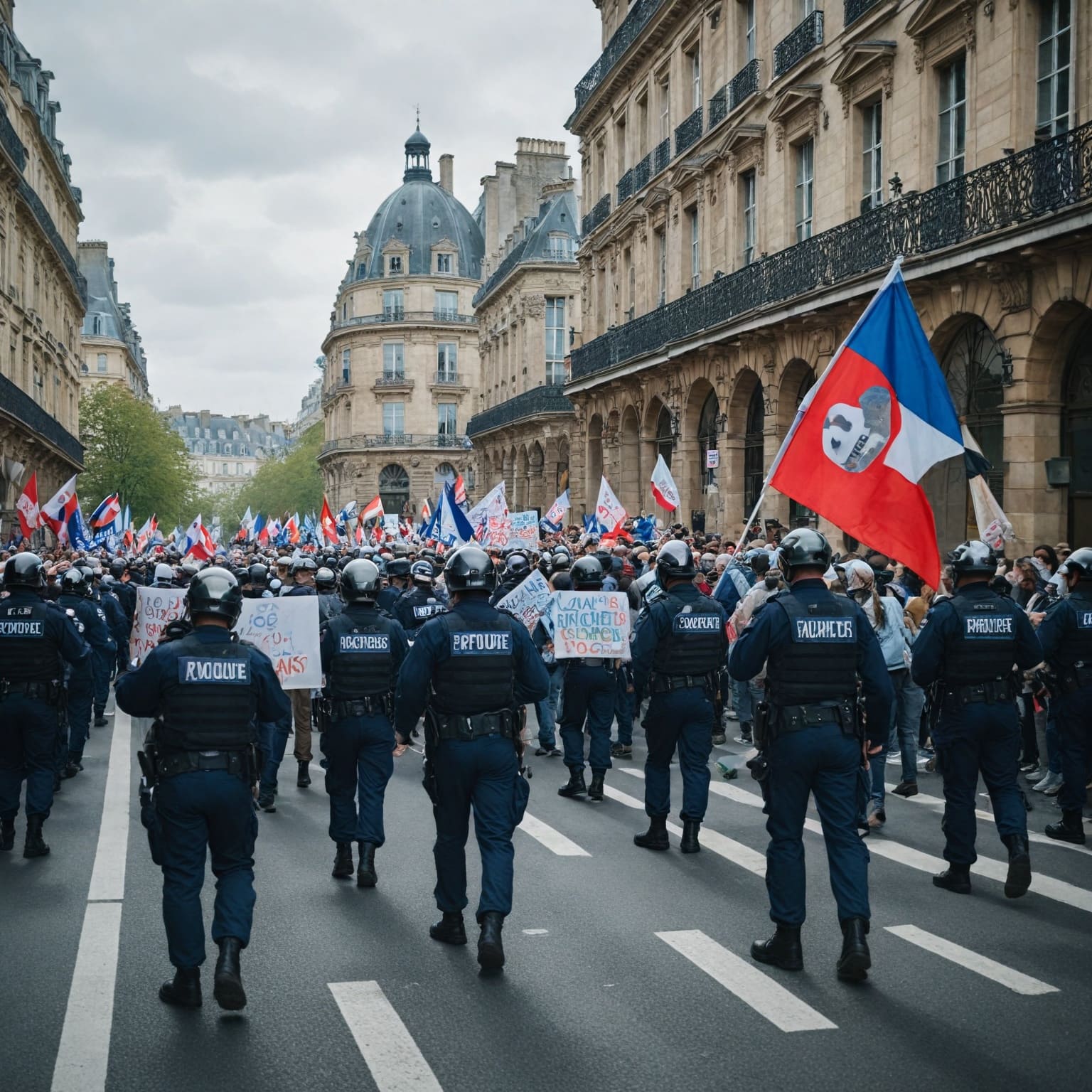
While the majority of May Day and other demonstrations remain peaceful, some have escalated into violence involving clashes between protesters and police, resulting in property damage, injuries, and arrests, further highlighting the volatility associated with far-right mobilizations.
Key Figures and Leadership
The leadership of the French far-right movement has been largely defined by the National Rally (formerly National Front), a party founded in 1972 by Jean-Marie Le Pen. Le Pen led the party for several decades, establishing its nationalist and far-right identity, although his tenure was marked by numerous controversies including allegations of Holocaust denial and anti-Semitism. In 2011, leadership passed to his daughter, Marine Le Pen, who sought to rebrand the party by distancing it from her father’s extremist rhetoric, culminating in his exclusion from the party in 2015.
Marine Le Pen played a pivotal role in transforming the party into a more populist and electorally competitive force. Under her leadership, the party adopted a nationalist, far-right ideology with elements of populism, advocating policies such as immigration reduction, increased French birth rates, and a professional army, while shifting from strong Euroscepticism toward reforming the European Union and maintaining the euro currency. In 2018, Marine Le Pen proposed and successfully pushed for the party’s rebranding as the Rassemblement National (National Rally), signaling a new phase in its evolution.
Following Marine Le Pen’s announcement of stepping down from party leadership in late 2024, the National Rally faces its first transition to a leader outside the Le Pen family. The main candidates to succeed her are Jordan Bardella, the party’s interim president, and Louis Aliot, Mayor of Perpignan. Both are considered close allies of Marine Le Pen, and while Bardella has adopted a hardline stance on issues such as banning dual nationals from certain state jobs, the party continues to blend nationalist and populist themes to broaden its appeal.
Other notable figures in the broader far-right milieu include Gilbert Collard, who was re-elected to the National Assembly alongside Marine Le Pen, and Ludovic Pajot, who became the youngest member of the French parliament at 23 years old under the party’s banner. However, internal divisions have persisted; the more radical faction criticized Marine Le Pen for moderation, leading to splits such as Florian Philippot’s departure to form The Patriots and Éric Zemmour’s creation of the more radical Reconquête party.
Beyond the National Rally, various far-right ideological currents continue to influence the landscape. Some adherents align with Alain de Benoist’s Nouvelle Droite think-tank, which promotes a pro-European and neopagan line, while others affiliated with the “national revolutionary” tendency have broken away to form minor parties like the Party of New Forces (PFN) and the French and European Nationalist Party (PNFE).
The far-right leadership remains central to the movement’s attempt to capitalize on nationalist sentiment and social discontent in France. While figures like Marine Le Pen and Jordan Bardella have sought to present the party as a legitimate political force capable of challenging the establishment, the far-right continues to face scrutiny for its historical associations and controversial rhetoric.
Main Events and Timeline of Demonstrations
The 2025 French far-right protests began in response to the conviction of Marine Le Pen in the National Front assistants affair, which rendered her ineligible to run for public office until 2030. Following the announcement of her ineligibility, the National Rally party organized national demonstrations to commence at 14:00 CEST on 6 April at the Place Vauban in central Paris. This initial gathering was reportedly supported by the sale of approximately 10,000 tickets for the Paris event, reflecting significant mobilization efforts by the party and its sympathizers. On 5 April, a smaller protest of about 500 people took place in Marseille to show support for Le Pen.
On 6 April, a large number of protesters assembled symbolically near landmarks such as Napoleon’s tomb and the golden dome of Les Invalides in central Paris. Demonstrators carried French flags and chanted slogans including “They won’t steal 2027 from us!” and “Marine Présidente!” These actions marked the beginning of a series of planned demonstrations across France by the National Rally and allied organizations. The protests were characterized by their far-right nationalist sentiment and were met with substantial counter-demonstrations from centrist and leftist groups.
These protests form part of a broader context of rising nationalist and far-right movements in Western Europe, with the French far right capitalizing on this sentiment. The National Rally’s actions occurred alongside a heightened political climate where concerns over immigration and border controls have become focal points in French political discourse. The protests in Paris and other cities underscored the polarization in French society, as evidenced by concurrent anti-racism and anti-fascism demonstrations organized by various left-wing and civil society groups, including significant gatherings on dates like the International Day for the Elimination of Racial Discrimination.
Earlier nationwide protests in France, such as those on 9 June 2024 in response to the National Rally’s victory in the European Parliament elections and subsequent political developments, set the stage for the intensified confrontations witnessed in 2025. These earlier demonstrations often involved unions and left-leaning parties expressing opposition to the far right’s ascendancy and the government’s decisions. While most demonstrations remained peaceful, there have been occasions when clashes between protesters and police led to violence, property damage, injuries, and arrests, highlighting the tensions inherent in these political conflicts.
Demonstrations’ Stated Motivations and Context
The demonstrations surrounding the recent surge of the French far-right, particularly the Rassemblement National (RN), have been framed by participants and organizers as responses to concerns over racism, hate speech, and the preservation of democratic institutions. Nationwide protests called for an end to policies perceived as discriminatory and fueling extremism, with a reported attendance of nearly 91,000 people across France, including more than 21,000 in Paris alone. These gatherings aimed to raise awareness about an environment that allegedly fosters hate speech and far-right extremism amid a rightward shift in French politics and government measures to tighten immigration controls and border security.
Supporters of the law and judiciary, which have recently faced criticism and threats from far-right elements, organized separate rallies in and around the capital. Left-wing and centrist parties sought to express support for the enforcement of legal decisions and to back judges subjected to death threats requiring police protection. Prime Minister François Bayrou called for these rival demonstrations to occur with “calm, mutual respect and a spirit of responsibility” to avoid violent clashes, characterizing the events as a “battle of images” reminiscent of an election campaign.
In parallel, the centrist Renaissance party, aligned with President Emmanuel Macron, staged a counter-demonstration in Saint-Denis. Its secretary general, Gabriel Attal, emphasized the importance of defending existing French political institutions against attacks by the far-right, particularly those directed at judges. This stance was bolstered by public opinion data showing that most French citizens considered the recent court rulings fair and the attacks on judges largely unpopular, especially among older voters.
On the other hand, the far-right and its supporters have framed the judicial actions against their leaders as politically motivated. Marine Le Pen, for instance, described her conviction as a “political decision” rather than a fair judicial ruling and accused foreign far-right figures such as Hungary’s Prime Minister Viktor Orban and U.S. President Donald Trump of “unprecedented interference” in French domestic politics by supporting her cause. This framing feeds into a broader narrative exploited by the National Rally, which capitalizes on xenophobic sentiments, advocating for stringent immigration policies and emphasizing national sovereignty over European integration. The party’s rhetoric appeals to voters concerned about cultural identity and economic stability, presenting itself as a defender against perceived threats from immigration and globalization.
The political context of these demonstrations is also shaped by longstanding historical debates and tensions in France related to nationalism, colonialism, and identity politics. Since the late 19th century, nationalist movements have at times blended ethnic nationalism with xenophobia and other exclusionary ideologies. The far-right has appropriated these elements, reinforcing a narrative of protecting French cultural and political integrity against external and internal threats.
Moreover, economic and social discontent in France has fueled broader dissatisfaction with the political elite, providing fertile ground for both far-right and far-left movements. Controversial government reforms in pensions and unemployment have sparked strikes and protests, reflecting widespread frustration with perceived governmental detachment from everyday struggles. Media coverage has also played a role by amplifying far-right rhetoric and sensationalizing immigration and cultural issues, contributing to the normalization of extremist viewpoints within political discourse.
Internationally, observers and
Organizational Profiles
The primary far-right political organization involved in the recent French demonstrations is the National Rally (Rassemblement National, RN), a party founded in 1972 by members of the Ordre Nouveau as the legitimate political vehicle for the far-right movement in France. Jean-Marie Le Pen led the party until 2011, after which his daughter Marine Le Pen took over leadership and initiated a strategy of “normalisation” and “dédiabolisation” aimed at broadening the party’s appeal beyond traditional far-right voters by softening its extremist image. This strategy enabled the RN to attract right-wing centrist voters and significantly increase its electoral influence.
Marine Le Pen proposed renaming the party from the National Front (Front National) to National Rally in 2018, a name with historical ties to French far-right politics dating back to the Rassemblement National Français led by Jean-Louis Tixier-Vignancour in the 1960s. The party’s ideology has been characterized as nationalist, far-right, and populist, combining elements of social conservatism with right-wing political values. The RN has focused on issues such as immigration reduction, increased French birth rates, professionalizing the military, and promoting a “French and European renaissance.” Despite its mainstreaming efforts, the party has faced controversy for its connections to more radical far-right groups, including Generation Identity, which the RN has covertly supported in plans to “remigrate” immigrants if it gains power.
Apart from the RN, other far-right factions have existed in France, including radical groups such as Occident, Groupe Union Défense (GUD), and Ordre Nouveau during the late 1960s and 1970s, as well as smaller splinter parties formed by former FN members, such as the Party of New Forces (PFN) and the French and European Nationalist Party (PNFE). These groups often espoused more extreme nationalist and neo-pagan ideologies, sometimes linked with the Nouvelle Droite think tank led by Alain de Benoist, which promoted a pro-European yet far-right cultural agenda.
On the opposing side, left-wing and centrist coalitions have mobilized against the rise of the far-right in France. For instance, the New Popular Front, a coalition of left-wing parties including the French Communist Party, has organized rallies and media campaigns to counter the far-right’s influence in elections and public demonstrations. These groups emphasize defending democratic institutions, the judiciary, and promoting social justice in response to far-right xenophobia and nationalist rhetoric. Unions, independent media, and citizen organizations have also coordinated efforts to denounce the far-right’s growing prominence and support the left-wing bloc during electoral contests.
In addition, during election periods and social unrest, various civil society actors, including shopkeepers and business owners, have organized communication networks such as WhatsApp groups to monitor demonstrations and maintain awareness of developments on the ground. The political climate has been further charged by widespread protests related to pension reforms, immigration policy, and broader social grievances, all of which provide a complex backdrop for the interplay between far-right movements and their opponents.
Public and Media Reaction
In the lead-up to the anti-racism rallies, the left-wing France Unbowed (LFI) party sparked significant controversy by publishing an image of Cyril Hanouna, a prominent figure in right-wing French media, as part of their campaign to encourage turnout. Hanouna, born into a Jewish family of Tunisian descent, was portrayed in a manner that critics argued echoed anti-Semitic tropes reminiscent of the Third Reich. The backlash was swift, prompting key LFI representatives to admit the decision was a “mistake” and withdraw the image from circulation.
The broader societal context has been marked by escalating political polarization and a surge in activism, fueled by ongoing issues such as the cost-of-living crisis, widespread distrust in government institutions, and heightened climate concerns. Social media platforms have played a pivotal role in accelerating and amplifying unrest, allowing demonstrations to spread rapidly and persist, thereby increasing their financial and social impact. Analysts predict that such events will continue well into 2023 and beyond.
In response to these tensions, left-wing and centrist parties organized separate rallies around Paris to support the enforcement of law and to defend the judiciary, which has faced death threats necessitating police protection. French Prime Minister François Bayrou urged that these rival demonstrations proceed with “calm, mutual respect and a spirit of responsibility” to prevent violent confrontations. Media outlets like Ouest-France characterized the situation as a “battle of images,” likening the intense public displays to an election campaign atmosphere.
Meanwhile, the far-right National Rally (RN) has leveraged xenophobic sentiments by emphasizing strict immigration controls and advocating for national sovereignty over European integration. This rhetoric resonates with voters concerned about cultural identity and economic stability, positioning the party as a defender against perceived threats from immigration and globalization. The RN’s growing influence is reflected in their leading position in polls ahead of the snap legislative elections scheduled for late June and early July 2023.
Critics have also pointed to the role of a more favorable media environment for the RN, with an increase in right-wing outlets that promote far-right themes and ideas. Despite Marine Le Pen’s defeat in the 2022 presidential election, she garnered over 40 percent of the vote—an unprecedented achievement for the French far right. Subsequent parliamentary elections saw the RN secure a record 88 seats in the National Assembly. By the end of 2023, polling data indicated a historic level of public acceptance and support for far-right positions among the French electorate.
The media coverage of these developments remains sharply divided, with some segments condemning the far-right’s rise and others portraying opposition protests as “ridiculous” and “undemocratic,” reflecting the deep societal divisions over the future direction of France’s political landscape.
Impact and Consequences
Far-right demonstrations in France have had significant social and political repercussions, influencing both public discourse and policy debates. One major impact is the amplification of xenophobic and nationalist sentiments, particularly through parties like the National Rally, which emphasize stringent immigration controls and national sovereignty. This rhetoric resonates with segments of the population concerned about cultural identity and economic stability, contributing to a shift in the political landscape marked by the rising prominence of far-right ideologies.
The demonstrations have also exacerbated social divisions, fueling distrust in governments and institutions already weakened by economic pressures such as the ongoing cost-of-living crisis. This environment has fostered political polarization and increased activism, often resulting in widespread unrest. Social media plays a critical role by enabling rapid dissemination of information and prolonging protest durations, which in turn escalates financial costs and societal tensions.
While many protests, including May Day demonstrations, remain peaceful, some have devolved into violent confrontations with law enforcement, leading to property damage, injuries, and arrests. These incidents underscore the volatility surrounding far-right mobilization and its capacity to disrupt public order.
Politically, the surge of far-right support, as reflected in recent electoral successes, challenges the future of the European project. It raises concerns about the erosion of solidarity, inclusivity, and equality within France and across the European Union. The mainstreaming of far-right narratives has been facilitated by media amplification of racist rhetoric and sensationalism related to immigration and cultural identity, which further polarizes society and undermines efforts toward collective progress.
Controversial government policies, such as pension and unemployment reforms, have often triggered strikes and protests that manifest the frustrations of citizens who feel disconnected from political elites. These dynamics highlight the complex interplay between economic grievances and the growth of far-right activism, revealing deep societal challenges that extend beyond mere electoral politics.
Controversies and Criticisms
The French far-right, particularly represented by the National Rally (formerly the National Front), has been a focal point of intense controversy and criticism over recent years. The party has been accused of promoting xenophobia, antisemitism, and Islamophobia, issues that have sparked widespread public outrage and political backlash. Marine Le Pen’s efforts to “de-demonise” the party by distancing it from its far-right roots and censoring controversial figures like her father, Jean-Marie Le Pen—who was expelled from the party in 2015 for hate speech and Holocaust denial—have only partially mitigated the party’s problematic reputation.
Scholars broadly classify the party’s ideology as nationalist, far-right, and populist, fitting into a historical tradition of “national populism” in France that merges social values typically associated with the left and political values of the right. Despite attempts at moderation and repositioning as part of the “popular right” to attract conservative voters, the party continues to face poor electoral performance and persistent allegations of extremism.
The rise of the National Rally and similar far-right movements has been accompanied by a surge in politically motivated violence, threats, and hate crimes targeting marginalized groups, including Jews and Muslims, as well as political opponents. This escalation has alarmed politicians across the spectrum and human rights organizations, highlighting the dangerous normalization of far-right ideologies within French society.
Demonstrations linked to far-right causes have often triggered counter-protests and heightened social tensions. For example, while far-right rallies have drawn support, they have also led to separate left-wing and centrist gatherings denouncing antisemitism and state Islamophobia, and defending judicial authorities facing death threats amid this polarized climate. The government’s response to these tensions has included banning some protests on grounds of public order, a move later challenged by judicial rulings that deemed blanket bans unlawful.
Critics also point to external influences and interference in French politics, with figures like Viktor Orbán and Donald Trump accused of supporting far-right candidates such as Marine Le Pen despite her ineligibility to run, thereby exacerbating domestic political divisions. Such dynamics have contributed to crises within established political parties and intensified the ideological battle lines in France.
The controversies surrounding the far-right have also ignited fears among minorities, especially Muslim women concerned about potential bans on the hijab framed as issues of women’s liberty, with many reporting daily harassment and discrimination. Public demonstrations have frequently reflected these deep social cleavages, with placards and slogans highlighting opposition to state policies perceived as Islamophobic or authoritarian.
Legacy and Broader Significance
The rise of the National Rally (RN), formerly known as the Front National (FN), and its increasing influence in French politics represent a profound shift in the country’s political landscape with far-reaching implications. Central to this transformation has been the party’s strategy of *dédiabolisation* or ‘de-demonisation,’ aimed at softening its image to appeal to a broader electorate beyond its traditional far-right base. This shift has allowed the RN to become a significant political force, although it remains linked to far-right ideologies, as demonstrated by uncovered connections to extremist groups like Generation Identity.
The broader significance of this development extends beyond domestic politics to the future of European unity. The mainstreaming of far-right narratives within France poses a challenge to the cohesion and democratic foundations of the European Union. The erosion of solidarity and inclusivity threatens to unravel collective progress, risking a repetition of historical periods marked by fear, division, and exclusion. This context underscores the need for vigilance and commitment to values of equality and fairness across member states.
At the heart of the RN’s ascent lies widespread economic and social dissatisfaction with the political elite, which has fueled disenchantment and empowered both far-right and far-left movements. However, the core values and policy proposals of these opposing ends of the political spectrum differ substantially. The political fragmentation and weakening of traditional parties in France have further facilitated the far-right’s advance, enabling the RN to capitalize on nationalist sentiments sweeping Western Europe.
Public reaction to the far-right surge has been significant, exemplified by large-scale protests across France, including a nationwide mobilization involving hundreds of thousands of participants. These demonstrations reflect deep concerns about the normalization of far-right ideas within French society and government circles, highlighting a widespread fear of rising fascism and intolerance. In response to the potential threat posed by an RN government, major leftist parties in France formed a coalition known as the New Popular Front, signaling a united front against the far-right’s growing influence.
Ultimately, the legacy of the National Rally’s rise and the associated far-right demonstrations encapsulate a critical juncture for French and European politics. The trajectory chosen in the coming years will determine whether democratic values and social cohesion can be preserved in the face of resurgent nationalism and political polarization.
The content is provided by Avery Redwood, News Scale